
Introduction
Local government today faces a perfect storm of challenges: chronic budget constraints, rising service demands, and growing public expectations. In many local authority districts, public trust is at an all-time low. For those working within councils and local authorities, this pressure translates into heavier workloads, strained resources, and increasing difficulty in meeting community needs.
Yet amid these pressures, artificial intelligence (AI) is emerging not just as a tool for optimisation, but as a pathway toward more resilient, equitable, and community-centered governance. Could AI help relieve the burden and even help us reimagine what local government could be? What if your council could respond to every citizen enquiry within 24 hours? What if AI could reduce administrative overhead while improving job satisfaction for staff? What if digital transformation could reach those most excluded from traditional services?
This article offers a structured overview of these questions - beginning with the pre-AI realities facing local government, examining lessons from early pilots and real-world examples, and concluding with a roadmap for responsible and ethical implementation at scale.
Article Overview
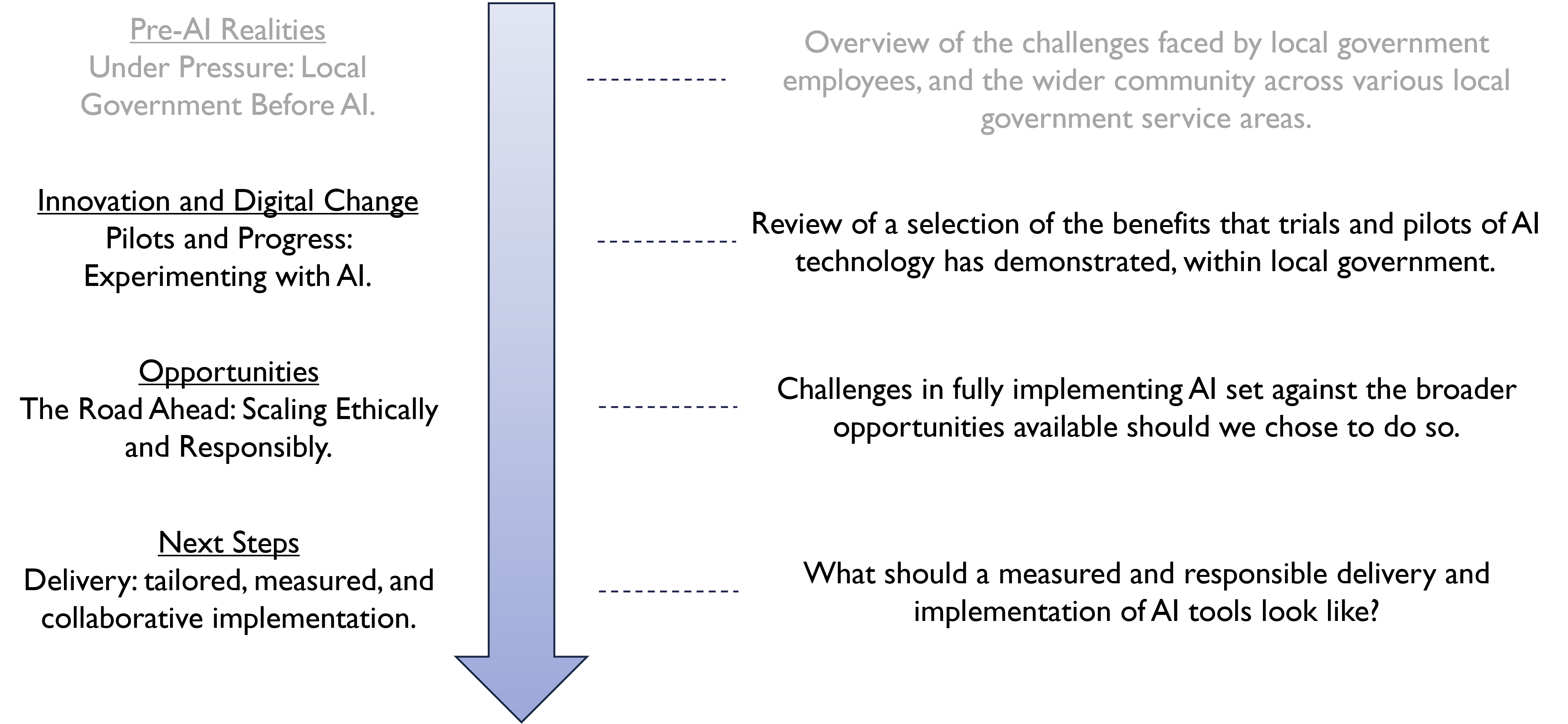
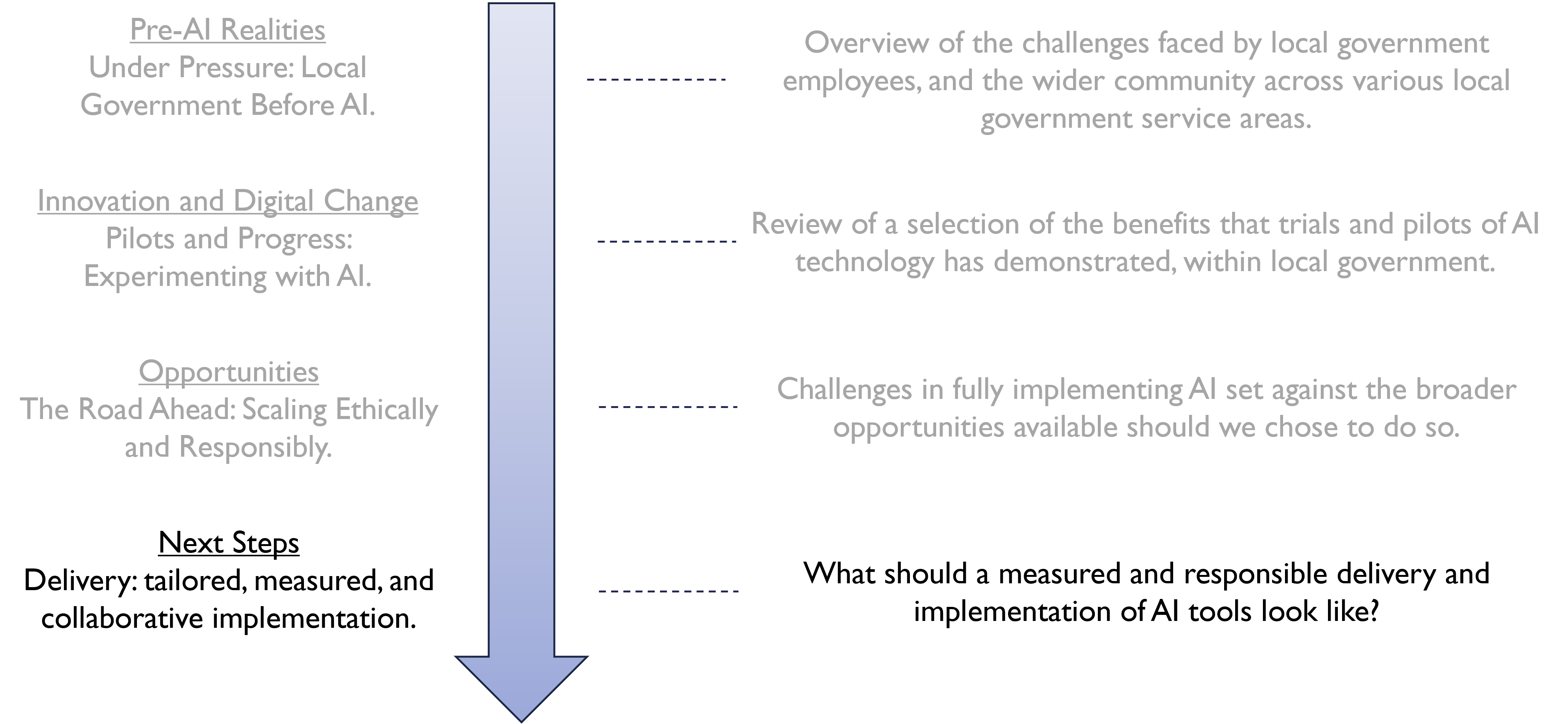
To understand the role that artificial intelligence might play in reshaping local government, I’ll follow a structured path, which I have illustrated in the visual below. The flow begins with the realities local authorities have faced before the introduction of AI and moves step by step toward practical guidance for responsible and collaborative implementation.

We begin with Pre-AI Realities, examining the mounting pressures facing councils: budget reductions, rising service demands, and growing public expectations. These constraints have strained not only operations, but also the morale and capacity of local government staff.
I then turn to Innovation and Digital Change, highlighting early pilots and digital experiments that local authorities have already undertaken. Here, I focus on the tangible benefits AI has begun to deliver; from increased efficiency and cost savings to improved staff well-being and resident engagement.
The third section explores Opportunities: The Road Ahead, reflecting on the potential to scale AI solutions more broadly. But this opportunity is not without risk. Implementation must be thoughtful, considering not just technological capability but also governance, ethics, workforce readiness, and public trust.
Finally, we conclude with Next Steps: Delivery, offering a framework for implementing AI tools in a way that is tailored to local needs, measured in its outcomes, and collaborative in its design. It is here, where vision meets delivery, that I consider how councils can move from exploration to real-world impact.
Together, these sections build a comprehensive picture of how local government can approach AI with ambition, realism, and care.
Pre-AI Realities: Under Pressure - Local Government Before AI
Strains on Staff and Services
Before the rise of AI in public sector innovation, local government was already under immense pressure across a range of service areas. These challenges involved issues such as:
- Inefficiencies and repetition in administration - causing time-consuming, burdensome tasks.
- Difficulties in managing large volumes of data and information retrieval.
- Limitations in service accessibility and engagement - representing significant barriers to community access.
- And constraints on staff resources and budgets threatening staff well-being.
Such challenges made it difficult for councils to operate effectively.
For example, according to reports published by the Local Government Association, social workers in Kingston Upon Thames spent an inordinate amount of time writing case notes and assessments, limiting their ability to engage with clients. Similarly, in Barnsley, repetitive tasks across departments consumed staff capacity. In Birmingham City Council, translation, redaction, and inbox management were flagged as key administrative pain points.
The creation of accessible “Easy-Read” documents in Swindon Borough Council was also a slow and expensive process, taking weeks and requiring significant social worker time. Finally, North Yorkshire Council reported that social workers were spending up to 80% of their time on administration, with significant effort required just to retrieve relevant data - thereby limiting their ability to draw upon past experiences in their efforts to respond proactively to family needs.
Limited Access and Engagement
The pressures facing local government extended well beyond internal workflows. They had tangible and often detrimental knock-on effects for the communities that councils served-particularly in relation to access and engagement. Digital exclusion was a major concern, and councils were under pressure to improve how residents accessed local government services and information.
North Somerset Council recognised the importance of developing a fuller understanding of digital exclusion. They acknowledged that digital transformation could not be genuinely inclusive unless it addressed the structural barriers that prevented access - barriers deeply intertwined with issues such as poverty, inequality, and vulnerability. Manchester City Council similarly identified digital exclusion as a significant obstacle to meaningful resident engagement, particularly among marginalised communities.
Even traditional forms of civic participation revealed limitations. Planning processes in West Oxfordshire and the Cotswolds District Councils, for instance, were found to lack the reach and inclusivity needed to engage communities meaningfully.
Innovation and Digital Change: Pilots and Progress - Experimenting with AI
Optimising service delivery, while meeting rising expectations, has made the need for innovation increasingly urgent.
In this context, the following questions arise:
- Can artificial intelligence help address the very real and complex challenges that local governments face?
- Can artificial intelligence support not just communities, but also the dedicated employees delivering those vital services?
There is a growing body of evidence - including many pilot projects supported and discussed by the Local Government Association – that the answer appears to be a resounding yes.
Artificial intelligence is already demonstrating how it can enhance service quality, improve access, reduce administrative burdens, and unlock data-driven insight.
Let’s explore a few of the key benefits and opportunities that have emerged from these early initiatives.
Strengthening Local Authority Capabilities
We’ll explore these benefits and opportunities in the context of two distinct groups:
First, lets consider those benefits that are inward-facing - focused on strengthening the capabilities of the local authorities themselves. These are the gains that support staff: for example, improving the working experience of employees, enhancing service efficiency, and unlocking better insights from data. They also include opportunities for better automation, decision making, smarter use of public funds, improved information governance, and fostering innovation.
Early pilots demonstrated that AI can relieve administrative burdens, improve staff satisfaction, and support better decision-making. Councils have used AI to automate back-office tasks, generate real-time insights, and streamline processes that once consumed days or weeks of staff time.
- Enhanced efficiency and productivity.
- Data insights and decision making.
- Cost savings.
- Support for staff well-being and job satisfaction.
- Fostering Innovation.
- Improved information governance and security.
A few real-world examples include:
- Kingston Upon Thames Council piloted “Magic Notes,” an AI tool that helps social workers write case notes. Time savings were estimated at 50–60%.
- North Yorkshire Council developed a proof-of-concept to improve information retrieval and generate eco-maps, reducing administrative workload by up to 90%.
- Swindon Borough Council used AI to speed up the creation of “Easy-Read” documents, increasing accessibility while lowering production time and cost.
Staff Well-Being and Productivity Gains
AI has also shown promise in improving workplace satisfaction through productivity gains. AI can free up staff time for more meaningful and value-added work; potentially increasing job satisfaction. By automating tedious tasks and improving efficiency, AI tools can contribute to a more positive and less stressful work environment.
At West Berkshire and Halton Borough Councils, custom chatbots assist with tasks like recycling FAQs, appointment scheduling, and internal HR queries. These tools not only increase efficiency, but also reduce the tedium of repetitive tasks.
Successful examples often reference Robotic Process Automation (RPA) - this is a non-invasive and cost-effective solution for back-office work, leading to expedited processing and heightened accuracy.
Examples here include:
- Streamlining back-office work such as payslip management and invoice processing.
- Reducing manual errors.
- Automating redaction – where Birmingham City Council used UiPath’s Document Understanding feature to address their overwhelming volume of paperwork.
- Meeting transcriptions and minutes can also be generated more efficiently with AI.
A particularly successful case is Somerset Council, which distributed 300 Microsoft Copilot licenses to staff. Without requiring formal training, the council recorded a return on investment between 4 and 10 times the cost. Neurodiverse staff reported an 88% increase in productivity.
Indeed, perhaps the broadest successful application of AI has been with Microsoft Copilot, effectively an intelligent next generation chatbot, which utilizes Large Language Model generative AI technology. This tool can access internal local government documentation, and as such has shown great promise across many local authorities and in many different task contexts
Overall, the initial pilots were all generally successful and gave employees and council members the opportunity to experience real-world use-cases while exploring safe implementation strategies for AI within their local authorities. Similar to Somerset Council’s success, Birmingham City Council also successfully leveraged Copilot. Their pilot of the system allows them to automate legal document summarisation and assist with Subject Access Requests, resulting in significant cost and time savings.
Data-Driven Decisions and Smarter Operations
AI is enabling more intelligent decision-making through better use of data. Dorset Council implemented acoustic monitoring in care homes to detect disturbances and prevent incidents. Lancashire County Council used AI to predict traffic congestion, while Warwickshire Council explored how language models could better identify access to healthy food in local communities. These are all examples of how AI can analyse large datasets to identify trends, predict future needs, and support evidence-based decision-making.
Improved Community Engagement
Now, let’s look at the outward-facing benefits - those that directly impact the communities that local governments serve.
- Service delivery.
- Enhanced engagement.
- Community satisfaction.
- Democratising and empowering communities.
Thus, beyond internal operations, AI is also being used to improve citizen engagement and service delivery:
- Manchester’s People’s Panel for AI involved residents in shaping AI-powered front-line services.
- Lancashire’s road maintenance project embedded stakeholder input into the design and deployment of AI solutions.
- Chatbots and virtual assistants now help guide citizens through administrative tasks, offering 24/7 support and reducing barriers to access.
AI can contribute to the quality and timeliness of interventions though enhanced data insights and decision making. Examples include:
- Visitor engagement and artefact preservation in cultural hubs.
- Improve transport services by predicting congestion and optimising traffic management.
- Analysis of citizen feedback from various channels (phone calls, letters, complaints) to understand performance and identify areas for improvement, ultimately delivering better services.
Opportunities – The Road Ahead: Scaling Ethically and Responsibly
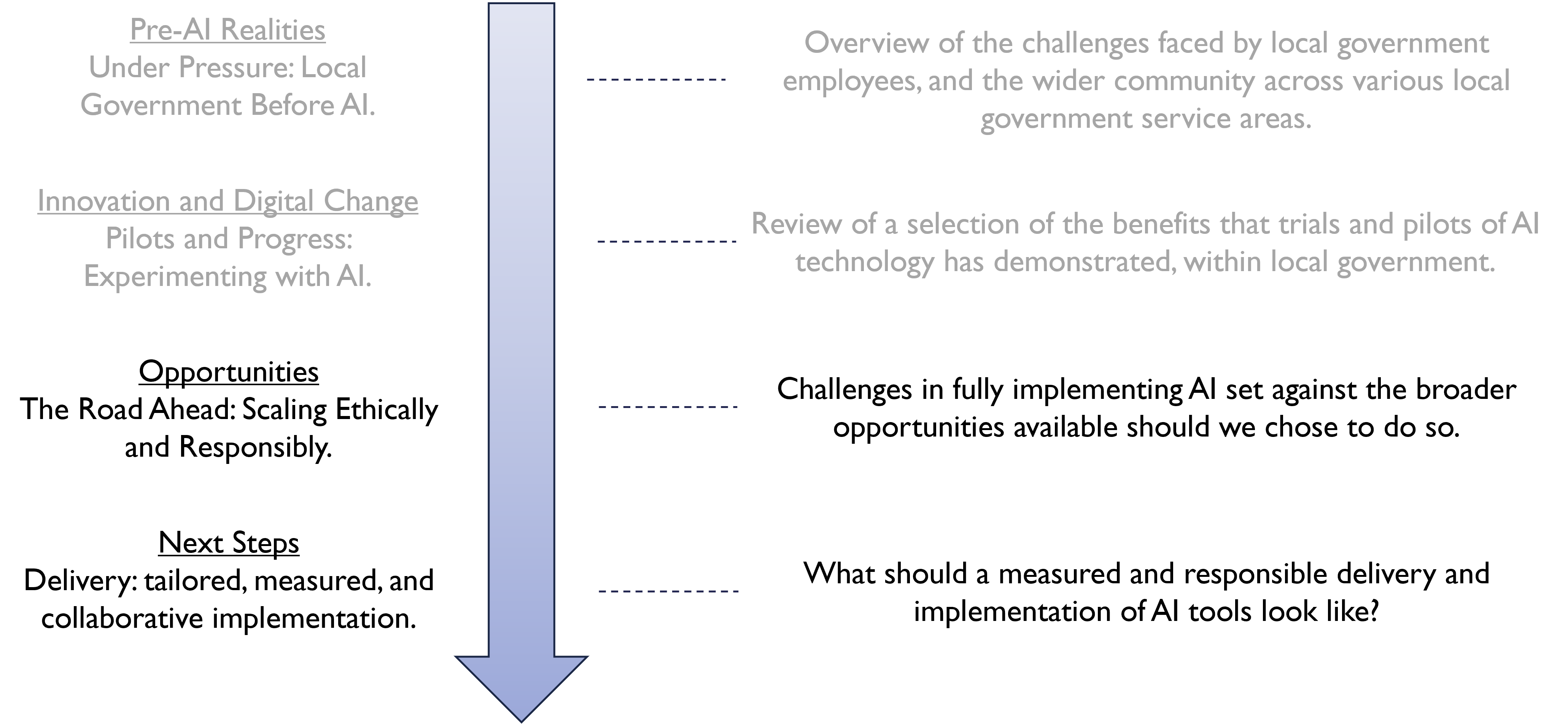
Scaling AI tools responsibly requires more than technology - it demands governance, transparency, public trust, and workforce transformation. Let’s now focus on the challenges we must address if we are to implement AI tools in a way that is ethical, effective, and sustainable.
From procurement and capability gaps, to data quality, staff training, and ethical oversight - these are not just technical hurdles, but organisational ones.
Challenges to Address
-
Human Element and Ethics AI must serve as a co-pilot, not a replacement. Councils must guard against depersonalised services and maintain a human-centric approach. Re-skilling and engagement with staff are critical to adoption and success.
-
Bias and Fairness AI can reproduce or even amplify existing inequalities if not properly monitored. Ensuring data diversity and algorithmic fairness is essential for equitable service delivery. The “Equality and Human Rights Commission” is actively monitoring the use of AI to prevent such biases.
-
Privacy and Security As more decisions are data-driven, the risks around data misuse, cyber threats, and surveillance increase. Strong safeguards and privacy-by-design policies are non-negotiable.
-
Transparency and Accountability Public trust will depend on councils clearly communicating how AI is used, who is responsible, and how ethical concerns are addressed. Independent oversight and rigorous evaluations will be necessary.
-
Technical and Cultural Readiness From hallucinations in AI responses (as seen in Buckinghamshire) to limited Excel integrations, councils are learning that AI is not always a silver bullet. Simple, well-understood data tools can still outperform LLMs in some contexts.
Next Steps – Delivery: Tailored, Measured, and Collaborative Implementation
So far, we’ve looked at the pressures local government face, the promise shown by AI pilots and experimentation, and the very real challenges of scaling responsibly.
Now, we turn to the most important question of all: What does responsible delivery actually look like?
To build AI tools that genuinely serve communities, councils must focus on both what they deliver and how they deliver it.
This dual focus leads to two sets of guiding principles:
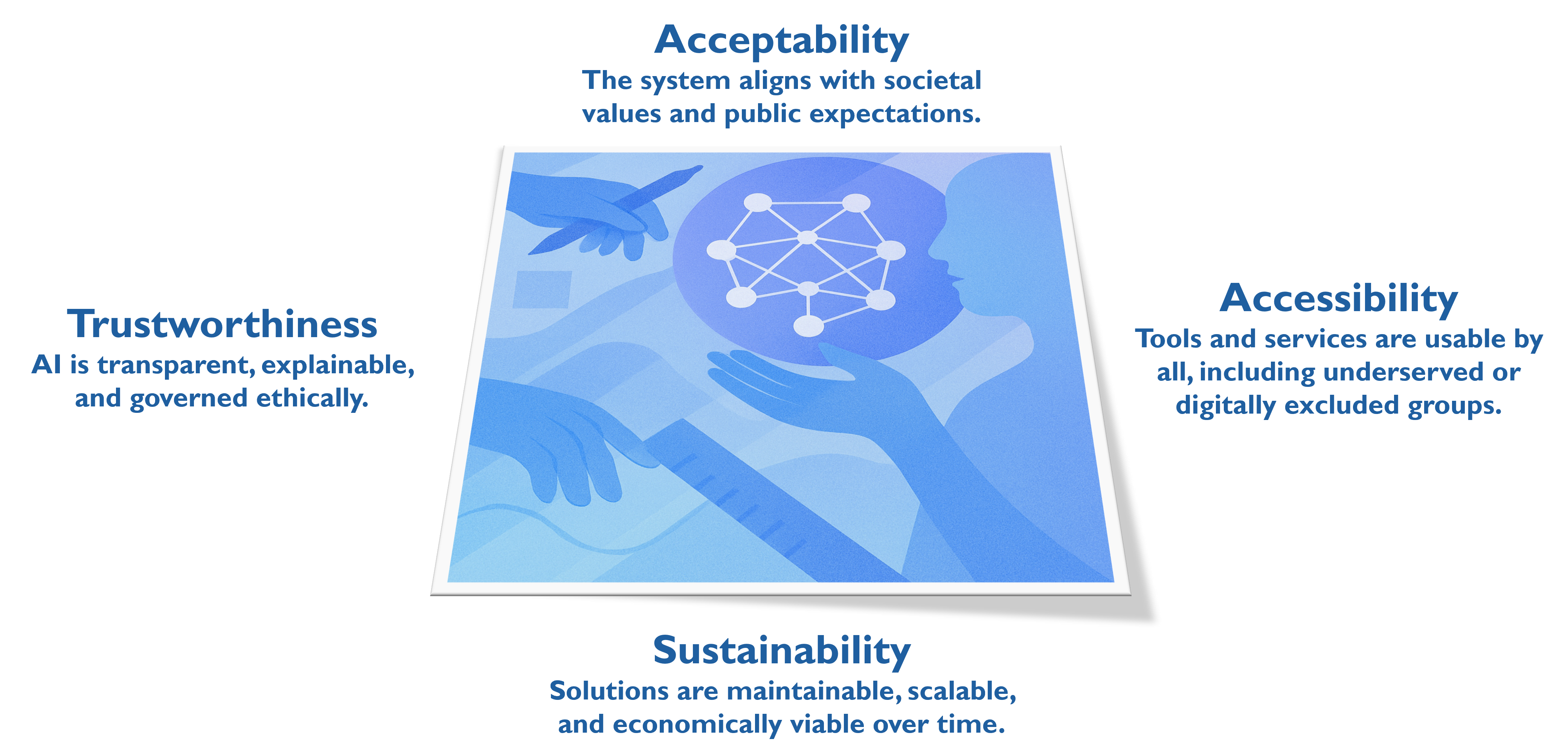
- What we are aiming to deliver: represented by the pillars Acceptability, Accessibility, Sustainability, and Trustworthiness. These are the outcomes we must strive for.
- How we will deliver: represented by the pillars Tailored, Measured, Collaborative, and Iterative. These are the principles that should guide how we build and implement AI solutions on the ground.
1. What We Deliver: The Pillars of Impact
To deliver AI tools that genuinely serve our communities, we need to focus on both what we are aiming to deliver, and how we will deliver.
-
Acceptability AI must align with public expectations and enhance staff capabilities, not replace them. AI should be user-friendly and intuitive for staff. Thus, we understand that engaging with staff and demonstrating the benefits of AI tools is crucial for increasing acceptance. AI should be seen as an assistive tool that supports human expertise rather than replacing it. We address staff hesitancy through open communication. And we demonstrate the tangible benefits of AI with a “Give it a Go!” attitude.
-
Accessibility Solutions must work for everyone-including those who are digitally excluded or underserved. AI solutions should improve access to services and information for residents. AI should help tailor how services are delivered to meet differing needs. We engage with residents, particularly those traditionally marginalised, to ensure AI solutions meet their needs.
-
Sustainability Tools should be economically viable and scalable long-term, showing measurable value for money. AI implementation should deliver value for money. We should explore cost-effective AI solutions and focus on efficiency gains and potential cost savings as our key drivers for AI adoption. We understand that the long-term benefits and return on investment of AI projects is necessary for securing continued investment.
-
Trustworthiness Ethical governance, explainability, and privacy protections must be foundational, not optional. Ensuring the safe and ethical use of AI is paramount. Establishing governance frameworks, ethics boards, and clear usage policies are crucial for responsible AI adoption. Prioritising data security and privacy is a key concern while maintaining human oversight and accountability for AI outputs is essential.
2. How We Deliver: The Pillars of Implementation
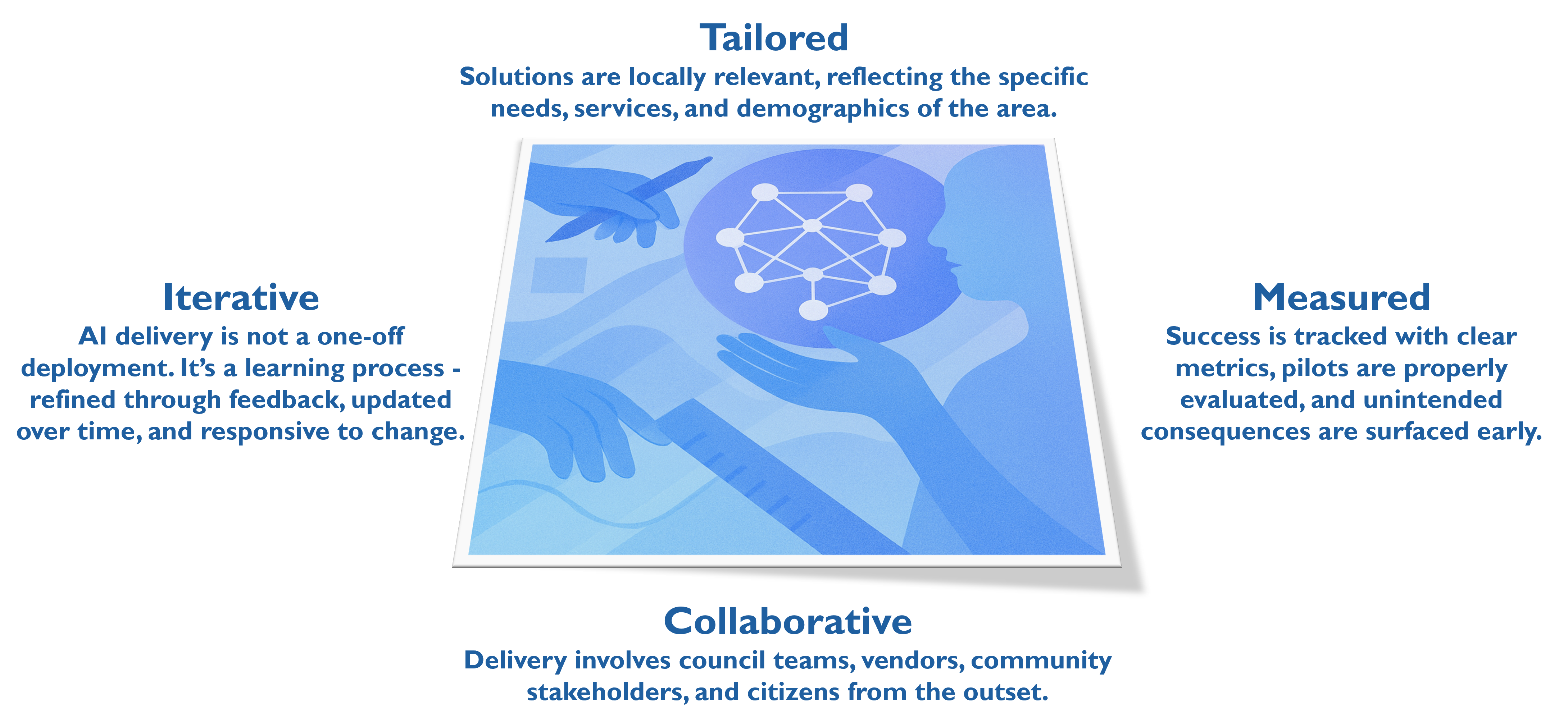
To deliver AI tools that genuinely serve our communities, we need to focus on both what we’re aiming to deliver, and how we will deliver.
-
Tailored Solutions must reflect local challenges and demographics, using real service pain points to guide development. We take a challenge-led approach that identifies specific service pain points and then explores how AI can provide solutions. Even when using off-the-shelf solutions like Microsoft Copilot, we pilot and explore use cases relevant to different departments and staff groups.
-
Measured Success must be tracked with clear metrics. Pilots should be structured, evaluated, and improved iteratively. We monitor and evaluate AI tool effectiveness and return on investment (ROI). Issues are collated and lessons learnt sessions are regularly held to disseminate learning. We follow a phased approach to implementation, allowing for learning and adjustments along the way.
-
Collaborative Councils must engage residents, staff, suppliers, and even academic partners in co-developing AI tools. We engage with residents and service users to ensure AI solutions meet their needs and address concerns. We understand that partnerships with technology providers are crucial for accessing expertise and developing solutions. We collaborate with academic institutions – where possible - to provide research expertise and to ensure ethical and inclusive AI development.
-
Iterative AI deployment is not a one-off project. It is a continuous learning process-refined by feedback and responsive to change. Our approach is agile, responsive, and adaptive. We actively learn and adapt based on regular progress reports. We try new approaches if we see an opportunity – and correct mistakes where and when they occur.
Conclusion
Artificial intelligence is not merely a technical tool for optimisation - it is a lever for shaping more democratic, more resilient, and more inclusive models of local governance.
But to realise this potential, we must proceed thoughtfully. This means engaging stakeholders early, maintaining public trust, investing in staff, and embedding strong ethical safeguards at every level.
If we get this right, AI will not just help us deliver services better - it will help us reimagine what local government can be.
References
- legislation.gov.uk.
- somerset.gov.uk.
- kerv.com.
- local.gov.uk - case studies - Somerset Council.
- local.gov.uk Artificial Intelligence Case Study Bank (2024).
- government-transformation.com.
- logicdialog.ai.
- committees.parliament.uk - LGA state of the Sector: Artificial Intelligence Survey_ (Feb 2024).
- committees.parliament.uk.
- theguardian.com.
- government-transformation.com.
- logicdialog.ai.
- circularonline.co.uk.
- Transport for West Midlands - local.gov.uk.
- Lancashire County Council - local.gov.uk.
- Equality and Human Rights Commission - wired-gov.net.
- adalovelaceinstitute.org.
- AWS podcast.
- ICS.AI.
- Essex.gov.uk blog.